By the PrototypeVerdict Test Team
Our Lovable link is a referral link: if you sign up through it, Lovable may reward us, at no extra cost to you. How we make money.
Lovable vs Claude Code: quick verdict
Short answer (from our hands-on tests): We gave both tools the same three prompts: a client intake portal, an invoice tracker and a landing page. Lovable, tested on its $25/month Pro plan (per Lovable’s pricing page) on Oct 29, 2026, scored 8.4/10. All three apps worked in about 16 minutes of build time with 1 fix message, and the portal saved accounts, uploads and submissions in Lovable Cloud, with a hosted preview in the browser. Claude Code, tested on a Claude Pro plan on Nov 10, 2026 (CLI version 2.1.322, model shown as claude-opus-5-5), built all three apps with 0 fix-up messages: a real Express and SQLite intake portal (every feature passed our checks at about 10 minutes), an invoice tracker in 3 minutes 23 seconds and a LedgerLight landing page in 2 minutes 20 seconds. Those apps ran on our own test computer, with no one-click public deploy. We have not scored Claude Code under our rubric.
Fairness caveats: these were not a same-day test. Lovable ran on a paid Pro plan on Oct 29, 2026. Claude Code ran on a paid Claude Pro plan on Nov 10, 2026. We did not repeat those three builds in Lovable on Nov 10, so we can’t confirm it still behaves the same today. Times below compare those two runs, not each tool on the same afternoon. We also couldn’t see how much of the Claude Pro session or weekly allowance the CLI runs used, because the CLI did not show it.
Our verdict
| If you… | Pick |
|---|---|
| Don’t write code and want a hosted preview, plus a real cloud backend for accounts and uploads from the first prompt (in our tests) | Lovable (Pro: Lovable Cloud on the portal and the landing-page form; a separate test client stayed out of admin) |
| Are comfortable in a terminal and want a real local backend you can inspect and run yourself | Claude Code (the portal was a local Express + SQLite app; you start it with Node) |
| Need a one-click public URL from the product | Lovable documents publish, custom domains (Pro and up) and Git sync. Claude Code, in our runs, left a project folder with no in-product publish button |
| Want only a fast browser preview and do not need real logins or file storage | Claude.ai chat artifacts were the fastest path to a clickable preview (the portal preview in about 2 minutes 44 seconds). That portal faked persistence: reload wiped the data, and logins were simulated |
| Need the invoice tracker stored in a database, not only in the browser, without asking | Neither in these runs. Both Lovable and Claude Code saved the invoice tracker in the browser (localStorage) |
What Claude Code is (and how it differs from Claude chat)
Lovable is a browser app builder: you type a prompt and preview a hosted project. Claude Code is Anthropic’s terminal coding tool. In our test it wrote a local project from the same pasted prompt, and we ran that project on our own test computer with Node. Anthropic’s pricing page lists Claude Code on paid individual plans (Pro, Max and Ultra), not on Free. Source: claude.com/pricing.
The same Claude Pro account can also build in the regular claude.ai chat window, which can produce clickable artifacts. We ran the same three prompts there earlier on Nov 10, 2026. Chat artifacts are a useful preview, not a substitute for Lovable or Claude Code when you need accounts, stored files or a durable server-side form. On the intake portal, chat-artifact logins were simulated, uploads kept only a file name and size, a reload wiped the state, and the admin view was unrestricted.
We have an older Claude Artifacts research page that predates these November builds. This comparison is the first write-up of the Claude Code CLI runs against Lovable’s standard three-prompt test.
Lovable vs Claude Code side by side
| Lovable (tested on Pro, $25/month, Oct 29, 2026) | Claude Code (tested on Claude Pro, Nov 10, 2026) | |
|---|---|---|
| Our score | 8.4/10 (review) | Not scored (see below) |
| Plan we tested | Pro, 100 credits ($25/month billed monthly) | Claude Pro ($20/month billed monthly, or $17/month if billed annually at $200 up front). CLI v2.1.322; model shown: claude-opus-5-5 |
| What it is, in our test | A browser builder with a hosted preview and built-in Cloud backend | A terminal coding agent that writes a local app you run yourself |
| Time to first independently running preview | Portal ~4 min · invoice tracker ~3 min · landing page not separately logged as “first preview” | Portal ~7 min 42 s (CLI finished in 7 min 41 s) · invoice tracker 3 min 23 s · landing page 2 min 20 s |
| Time to a working app | Portal ~9 min (1 fix) · invoice tracker ~4 min · landing page ~2 min 50 s (about 16 min in total) | Portal ~10 min under independent checks · invoice tracker and landing page working on the first build (0 fixes). Sum of the three CLI processes: 13 min 24 s |
| Fix messages | 1 (make the first admin) | 0. Creating the first portal admin used a documented npm run create-admin command; we did not count that as a fix-up |
| Usage for the three builds | 5.5 of 100 monthly credits from the balance (1 + 3 + 1.5), plus the day’s 5 free daily build credits | CLI reported a list-price equivalent of $1.82 + $0.94 + $0.68 = $3.44 across 65 turns. No extra usage was purchased. What share of a Claude Pro session or week that represents is not verified |
| Where the data was saved | Lovable Cloud for the portal and the landing-page form; browser only for the invoice tracker | Local SQLite plus files on disk for the portal; browser localStorage for the invoice tracker; a local JSONL file for landing-page contact rows |
| Sign-up in the portal | Email and password with an email confirmation link; addresses on example.com were rejected | Email and password, no email confirmation. Real sessions (cookie + scrypt password hashes in our independent checks) |
| Separate client-account check | Passed (no Admin link, own submissions only) | Passed (the other client received 404 on the first client’s submission and documents) |
| Code / export | ZIP downloaded (100 files) on Pro; Git sync with GitHub, GitLab or Bitbucket offered | The “export” is the project folder itself. No Git button and no ZIP download in these runs |
| Publish / hosting | Unpublished preview URLs on lovable.dev. We did not click Publish in the October feature builds. A security scan is documented at publish | No one-click public URL. The portal README describes self-hosting behind HTTPS and backing up the data directory. We did not deploy it |
| Phone layout | All three passed at 400px CSS width (no physical phone) | All three checked at 390px CSS width; no horizontal overflow (no physical phone) |
Test rows come from our logs: Lovable on Oct 29, 2026 (Lovable review) and Claude Code on Nov 10, 2026, with the same three prompts pasted word for word. The method is on how we test.
We have not put an overall score on Claude Code. Our scores come from the same weighted rubric for every tool. This Claude Code run was on a different day from the Lovable run, it is a terminal workflow rather than a hosted builder, and we have not applied that rubric to it.
Same prompts, side by side: what each tool built
Every tool we review gets the same three prompts, pasted word for word, with at most five fix messages per build. Here’s how Lovable (Pro, Oct 29) and Claude Code (Claude Pro, Nov 10) handled each one. A third column notes what Claude.ai chat artifacts did with the same prompts that morning, so the two Claude surfaces are not mixed together.
| Build | Measure | Lovable (Pro, Oct 29) | Claude Code CLI (Pro, Nov 10) | Claude.ai chat artifacts (Pro, Nov 10) |
|---|---|---|---|---|
| 1. Client intake portal | Time to first preview | ~4 min | ~7 min 42 s independently serving (CLI finished in 7 min 41 s) | ~2 min 44 s |
| Time to working | ~9 min | ~10 min under independent checks | A clickable preview in ~2 min 44 s, but not a securely working multi-user portal | |
| Fixes | 1: make the first admin and add an admin link in the nav | 0 (first admin is created with a documented CLI command, not a chat fix) | 0, but auth and storage were simulated | |
| Persistence / backend | Lovable Cloud, set up automatically. File upload persisted. Status change persisted after refresh. Isolation passed | Local Express app with SQLite and files on disk. Downloaded file bytes matched the originals. Isolation passed. Data survived a server restart | In-memory / simulated auth. Reload wiped data. Uploads kept name and size, not file contents. Admin view unrestricted. Failed as a real portal | |
| Usage | 1 credit from the balance, plus that day’s 5 free daily build credits | List-price equivalent $1.82 (34 turns). Share of Pro allowance not shown | Part of the morning’s chat-artifact run (see pricing) | |
| 2. Invoice tracker | Time to first preview | ~3 min | 3 min 23 s | ~3 min 49 s |
| Time to working | ~4 min (working on the first build) | Working on the first build | After 1 fix for Draft overdue | |
| Fixes | 0 | 0. Automatic Overdue included a past-due Draft on the first build | 1: Draft invoices past their due date were not marked Overdue until a fix | |
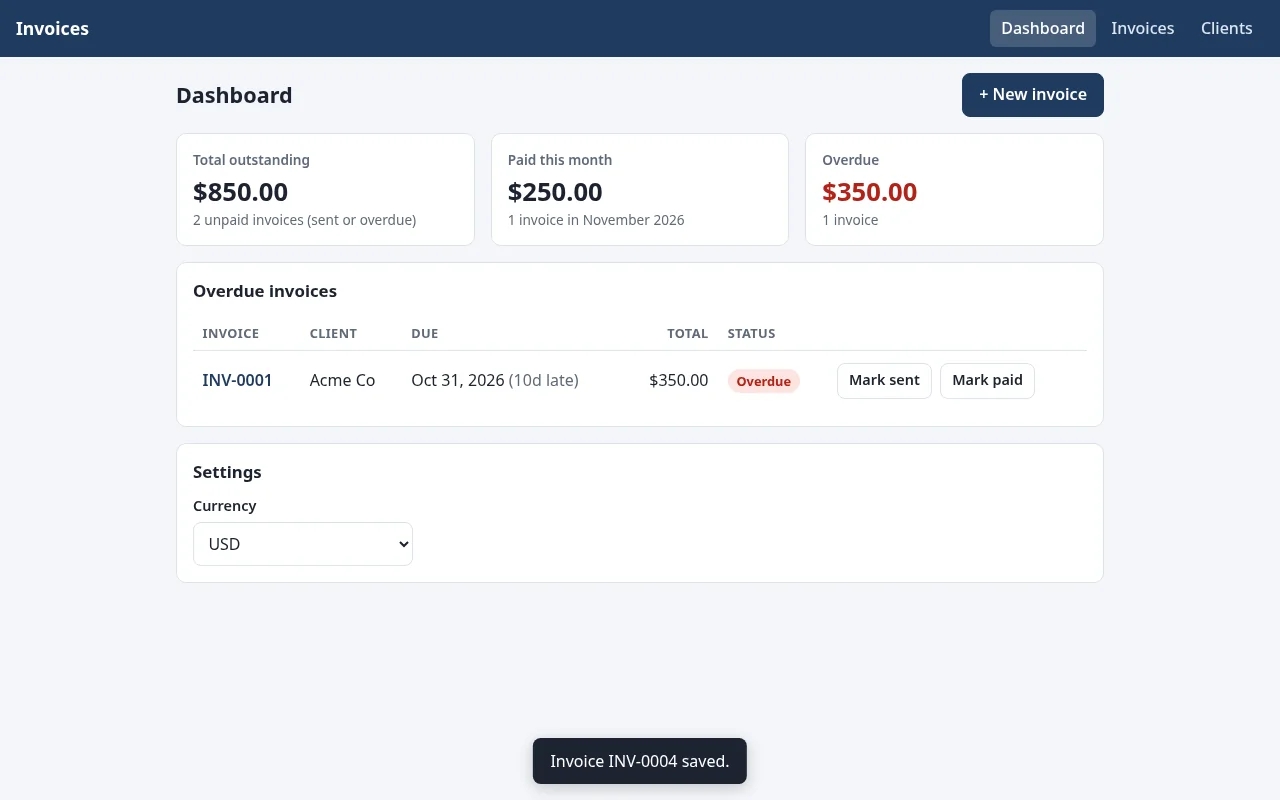
| Persistence / backend | Features passed, including $350.00 and $602.00 invoice totals. Data appeared to be browser localStorage only; another preview origin showed $0.00 | Features passed, including automatic Overdue on a Draft due Oct 31, 2026. Dashboard math we checked: $850 outstanding and $250 paid this month, then $350 outstanding and $750 paid after marking a Sent invoice Paid. Refresh and same-profile restart passed. Storage was localStorage; no server database | After the fix, persistence passed via Claude artifact storage with a localStorage fallback. Single-user | |
| Usage | 3 credits from the balance | List-price equivalent $0.94. Share of Pro allowance not shown | Part of the morning’s chat-artifact run | |
| 3. LedgerLight landing page | Time to first preview | Not separately logged | 2 min 20 s | ~3 min to first rendered preview |
| Time to working | ~2 min 50 s | Working on the first build | After 1 fix so the contact form could submit in the preview | |
| Fixes | 0 | 0 | 1: the preview sandbox blocked the form until a fix | |
| Persistence / backend | Contact form saved to a Lovable Cloud table. No email notification on submit | Contact form appended a JSON line to a local file, confirmed in the UI and with a no-JavaScript POST. Rows were still there after a server restart. No email notification and no admin screen for reading leads | After the fix, submissions saved only in browser localStorage. A real site would need a form service | |
| Usage | 1.5 credits from the balance | List-price equivalent $0.68. Share of Pro allowance not shown | Chat-artifact totals for all three prompts that morning: session usage 0% → 12%, weekly usage 0% → 2%, $0 extra credits, 2 fix-up messages |
Lovable’s credit accounting can disagree between the balance and the usage page; full write-up in our AI app builder usage study. We report the balance figures (5.5 credits across the three builds).
Build 1: client intake portal
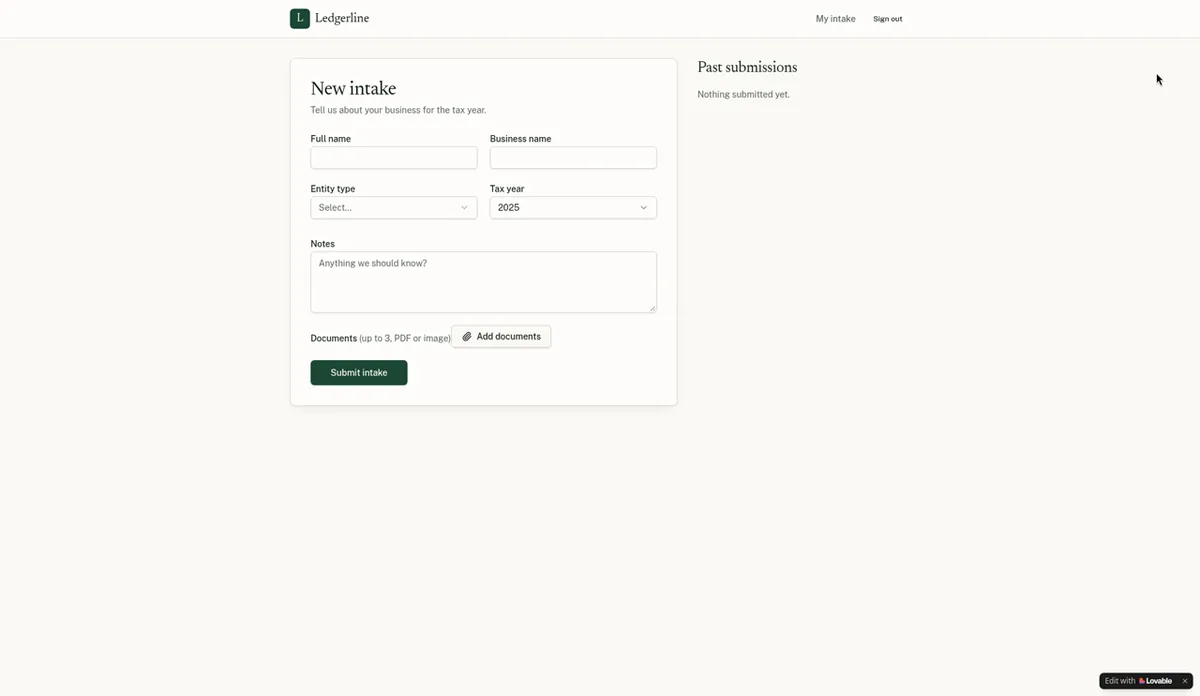
Lovable (about 9 minutes, 1 fix): sign-up and login with email confirmation, the intake form with the entity-type dropdown and tax year, file uploads, a client’s own submissions list and an admin table where a status change was still there after a refresh. Data lived in Lovable Cloud. There was no built-in way to make the first admin, so we sent one message asking for it. After the confirmation link, the portal page was blank until we signed in again. A separate non-admin test client saw no Admin link and only its own submissions.
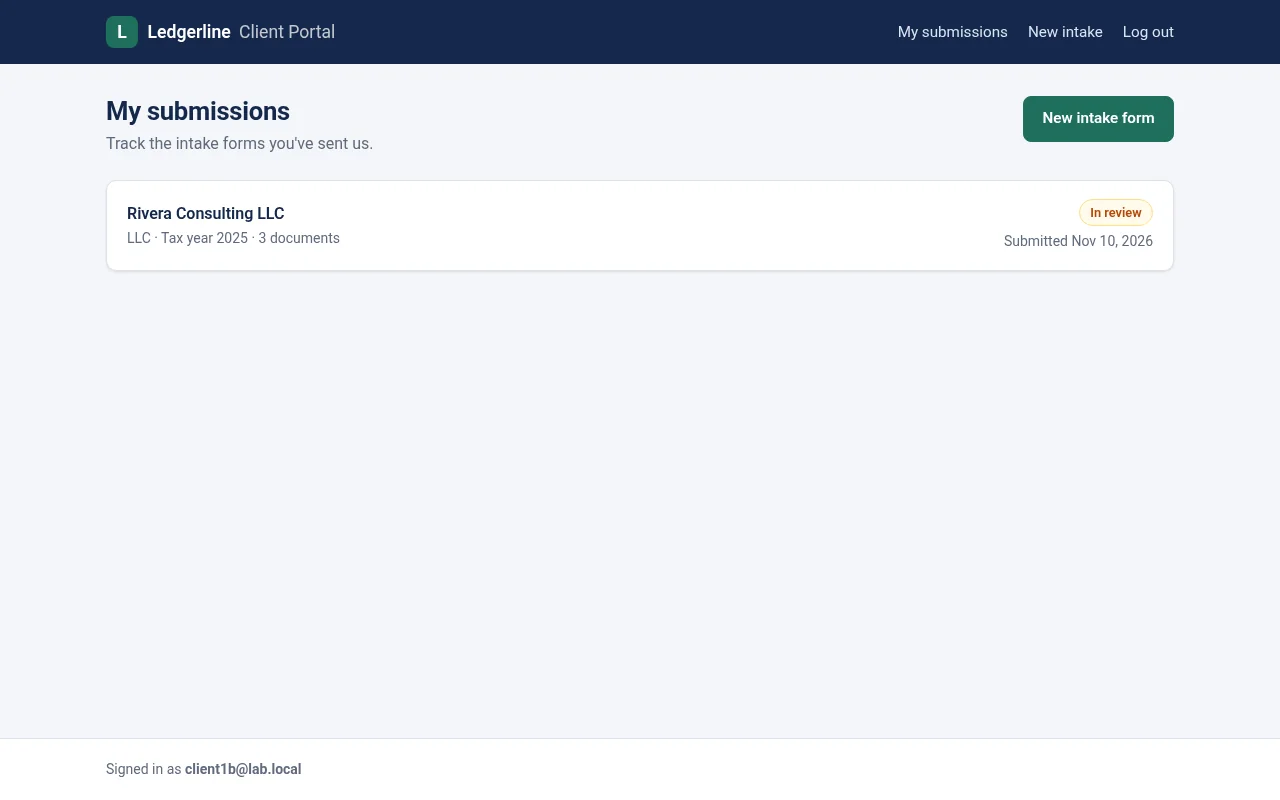
Claude Code (CLI finished in 7 minutes 41 seconds; independently working in about 10 minutes, 0 fixes): a local Express app with a SQLite database and uploaded files stored on disk. Independent checks passed for real sign-up and login (no email confirmation), the intake form, three fixture files whose downloaded bytes matched the originals, client isolation, an admin status change from New to In review, and survival of a process restart. The first admin is created with npm run create-admin, as the generated README documents. That is a setup step, not a broken preview, so we did not count it as a fix-up. There is no hosted URL unless you deploy the folder yourself.
Claude.ai chat artifacts (about 2 minutes 44 seconds, 0 fixes): a clickable preview appeared quickly. In that preview, logins were simulated, uploads kept only name and size, a reload wiped the session and submissions, and the admin view was not restricted. That surface failed our backend and auth checklist. It is the reason we do not treat “Claude” as one product in this comparison.
Build 2: invoice tracker
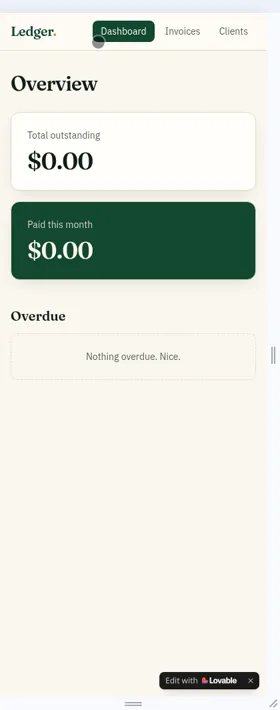
Lovable (about 4 minutes, 0 fixes): clients, invoices with line items and automatic totals ($350.00 and $602.00), Paid status, automatic Overdue and dashboard totals all worked, and data survived a reload. The data appeared to be saved in the browser only. Opened from a different address, the dashboard showed $0.00.
Claude Code (3 minutes 23 seconds, 0 fixes): clients, line-item totals, automatic Overdue — including a Draft invoice due Oct 31, 2026 — a dashboard, refresh persistence and a same-browser-profile restart all passed. Outstanding in our checks counted Sent and Overdue invoices, not Drafts that were not yet overdue; the prompt did not define “outstanding” more tightly than that. Storage was browser localStorage, with no server database.
The lesson for both: if an app stores business records, ask for a database in your first prompt. Neither Lovable nor Claude Code chose a server database for the invoice tracker on its own.
Chat artifacts needed one fix before a past-due Draft was marked Overdue. After that fix, refresh persistence passed in Claude’s artifact storage, with a localStorage fallback.
Build 3: LedgerLight landing page
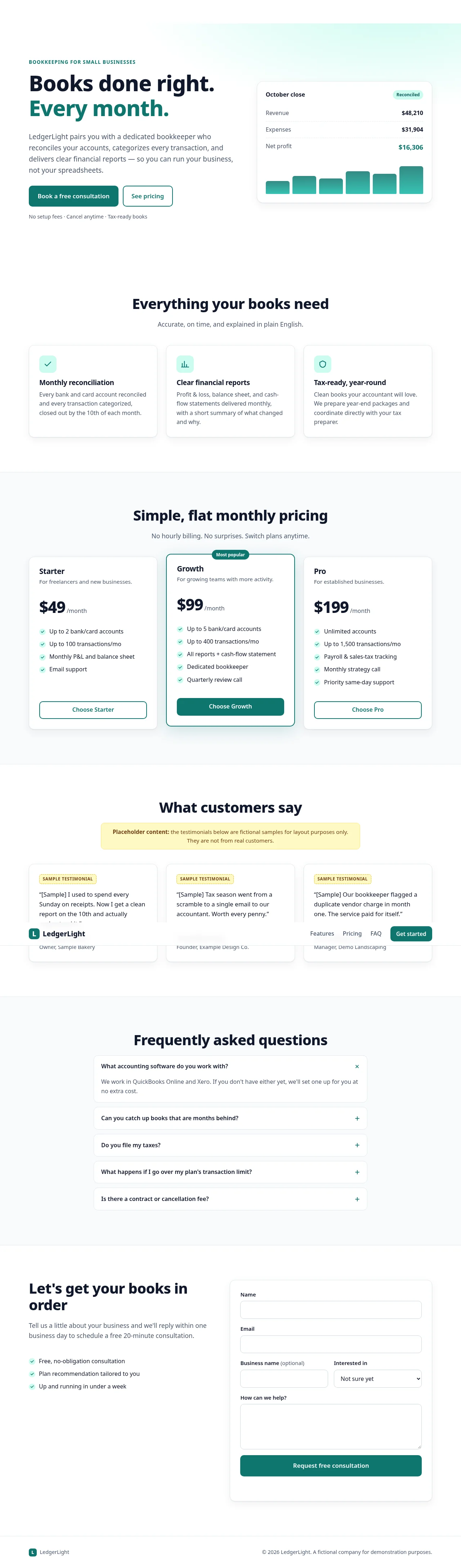
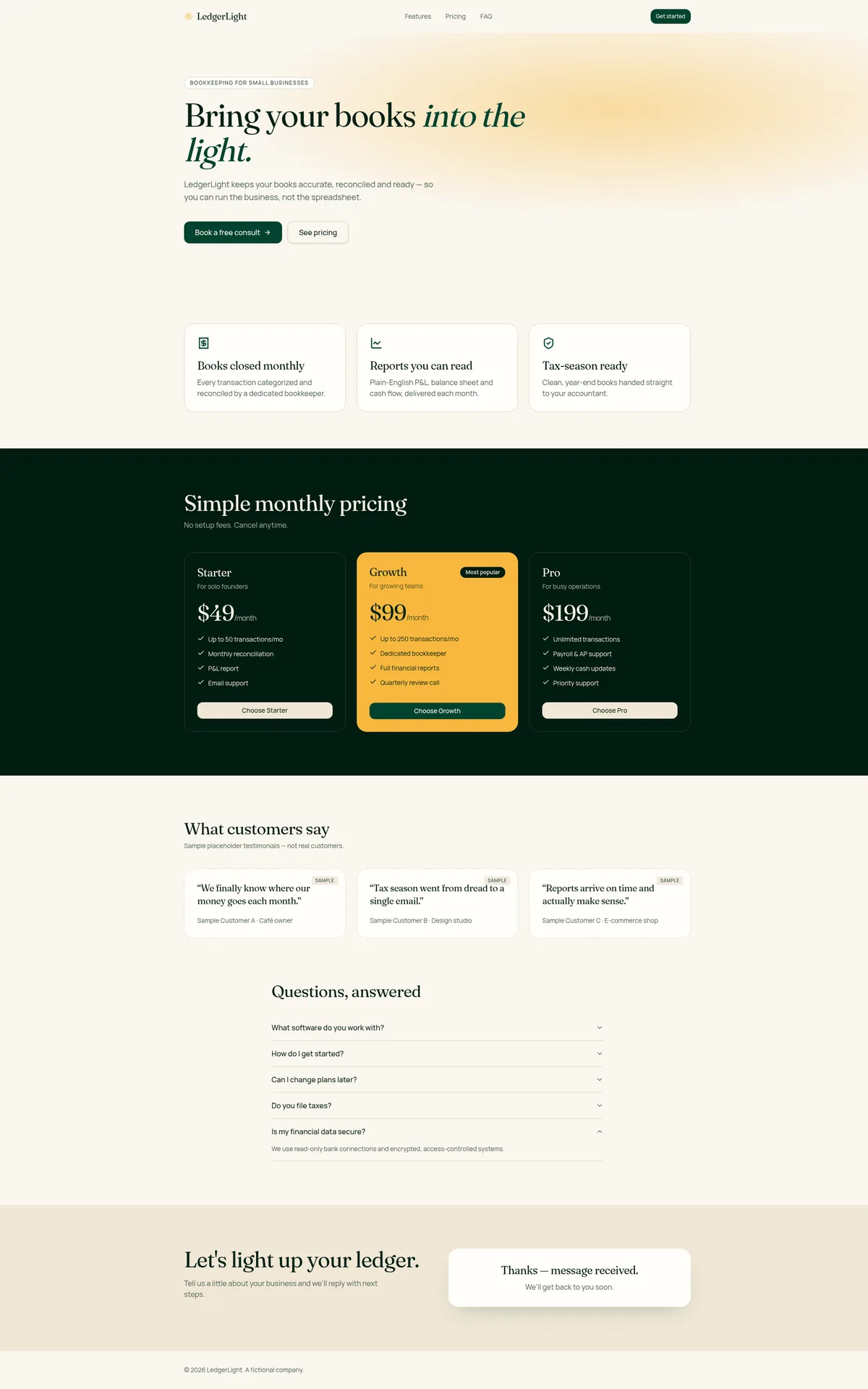
Lovable (about 2 minutes 50 seconds, 0 fixes): hero and call to action, three features, the $49/$99/$199 pricing table, testimonials labeled as samples, a five-question FAQ and a contact form that saved to a Cloud database table. It didn’t send an email when the form was submitted. FAQ and plan copy were invented by Lovable.
Claude Code (2 minutes 20 seconds, 0 fixes): the same requested sections, including the $49/$99/$199 monthly tiers, sample testimonials and a five-question FAQ. The contact form saved each submission as a JSON line in a local file, through a small Node server that needed no npm packages. Rows were still there after a restart. There was no email notification and no admin UI for reading leads. We did not test email delivery on either tool.
Claude.ai chat artifacts (about 3 minutes to first preview, then 1 fix): the form failed in the preview sandbox until we asked it to save a fake submission without connecting a service. After that fix, leads lived only in browser localStorage.
Pricing and usage
Claude (including Claude Code)
| Plan | Price | Claude Code | Notes from the official page |
|---|---|---|---|
| Free | $0 | Not included | Limited usage every 5 hours and every week; artifacts are included |
| Pro | $20/month billed monthly; $17/month with annual billing ($200 billed up front) | Included | The plan we tested. More usage than Free, every 5 hours and every week |
| Max | $100/month | Included | 5× Pro usage every 5 hours and every week. We did not test Max |
| Ultra | $200/month | Included | 10× Pro usage every week; no 5-hour limit for verified accounts. We did not test Ultra |
Source: claude.com/pricing. Prices are in USD and do not include applicable tax. Anthropic’s FAQ on that page says Claude Code is included in all paid plans and shares the same usage pool as chat. Team and Enterprise plans also list Claude Code; we did not test them, and we are not quoting seat or contract prices beyond what the individual cards show.
Our three Claude Code CLI builds reported a combined list-price equivalent of $3.44 ($1.82 + $0.94 + $0.68) and 65 turns. That figure is what the CLI labeled as list cost. It is not an extra invoice we paid on top of Pro, and it is not a claim that $3.44 is “inside” or “outside” a given Pro usage window. The CLI didn’t show that percentage, so we can’t say. Extra / fast-mode usage was off.
The same morning’s Claude.ai chat-artifact run on Pro showed session usage moving from 0% to 12% and weekly usage from 0% to 2%, with $0 extra credits and 2 fix-up messages. Those percentages apply to the chat-artifact session only. They are not a substitute for the missing CLI percentages.
Lovable
| Plan | Monthly credits | Billed monthly | Billed annually |
|---|---|---|---|
| Free | 5 build credits a day (up to 30 a month) | $0 | $0 |
| Pro | 100 | $25/mo | $250/yr ($21/mo) |
| Business | 100 | $50/mo | $500/yr ($42/mo) |
| Enterprise | Volume-based | Contact sales | Contact sales |
Sources: docs.lovable.dev/introduction/subscription-plans and lovable.dev/pricing. Prices in USD. The official docs table lists these as the 100-credit entry tiers for Pro and Business; higher credit tiers (up to 10,000 credits a month) are also listed there. Annual billing is described as two months free compared with paying monthly. Workspaces have no per-seat charge; plans are priced by credits, per those docs.
On Pro, our three October builds used 5.5 credits from the 100-credit monthly balance, plus that day’s 5 free daily build credits. We report the balance figures; the usage page disagreed slightly, as the usage study explains. The cost calculator runs the numbers for a chosen plan. A fuller plan-by-plan walkthrough is on Lovable pricing explained.
Which costs less is not a single number. The subscriptions we used list at $25/month (Lovable Pro, billed monthly) and $20/month (Claude Pro, billed monthly). Lovable’s three builds drew 5.5 credits from a 100-credit balance. Claude Code’s three builds reported $3.44 of list-price usage against a Pro subscription whose remaining allowance we could not read. Hosting is part of Lovable’s product; Claude Code left us a folder to host ourselves, and we did not measure production hosting cost.
Setup skill and deploy path
- Lovable: browser only. No local runtime to install. Cloud backend appeared automatically on the portal. The practical setup snag in our log was making the first admin (one chat prompt) and confirming email.
- Claude Code: requires a terminal, a signed-in paid Claude account, and Node for these apps. The portal also needed
npm installandnpm run create-adminbefore an admin could use it. The invoice tracker was a static folder. The landing page ran withnpm startand no extra packages. This is a developer workflow, not a no-install hosted preview. - Claude.ai chat artifacts: no local install. Claude asked which version to build on the portal (we chose the clickable prototype). There was no server to run and no real multi-user deploy from that surface.
None of the lab runs were published to a public host.
- Lovable projects had unpublished preview URLs. We downloaded the portal codebase as a ZIP (100 files) and saw Settings > Git two-way sync with GitHub, GitLab or Bitbucket (it creates a new repo; importing an existing repo was not supported in that screen). Publish itself was not exercised in the October feature builds.
- Claude Code‘s deliverable is the project folder. The portal README describes self-hosting behind HTTPS and backing up the data directory. The landing-page README notes binding beyond localhost to accept non-local connections. There was no one-click public URL and no in-product publish control in these runs.
Backend, data and code
- Database: Lovable set up a real Cloud database for the portal and the landing-page form without being asked, and saved the invoice tracker in the browser only. Claude Code built a real local SQLite database for the portal, a local JSONL file for landing-page leads, and used the browser for the invoice tracker. Neither tool asked us for a Supabase key or other third-party cloud credential on these three prompts.
- Sign-in: Lovable used email and password with a confirmation link, on Lovable Cloud. Claude Code used email and password with cookie sessions and no confirmation email.
- Who sees what: both portals passed a separate-client check in these runs (Lovable: no Admin link and own submissions only; Claude Code: the other client received 404s). Chat-artifact admin access was unrestricted.
- Files: Lovable persisted portal uploads on Cloud. Claude Code persisted file bytes on disk (hashes matched our fixtures). Chat artifacts did not keep file contents.
- Code: On Pro, Lovable’s “Download codebase” gave us 100 files, and Settings offers Git sync. Claude Code leaves the source in the folder it wrote. We have not taken the Lovable ZIP and hosted it on our own servers.
- Production load, backups and long-term hosting cost: not measured.
Pros and cons
Lovable
- Pro: In our October Pro test, all three apps worked in about 16 minutes of build time, with 1 fix, in the browser
- Pro: Portal and landing-page form used Lovable Cloud; a separate client stayed out of admin
- Pro: Hosted preview, code download (100 files) and Git sync confirmed on Pro
- Pro: No per-seat pricing, per the plan docs
- Con: We tested a paid plan; the free allowance is 5 build credits a day, up to 30 a month
- Con: The invoice tracker saved data in the browser until asked for a database
- Con: No built-in way to make the first admin
Claude Code
- Pro: Built all three test apps with 0 chat fix-ups, including a real local Express + SQLite portal
- Pro: You can open the generated code, run it yourself and keep the project folder
- Pro: Client isolation and file-byte persistence passed our independent checks on the portal
- Con: Requires a terminal, Node and a paid Claude plan. Official pricing lists Claude Code off the Free plan
- Con: No one-click hosted deploy in our runs; you are responsible for putting the app on the internet
- Con: The invoice tracker still saved data in the browser unless you ask for more
When NOT to use each
When NOT to use Lovable
- You want to work only in a local repo and keep the server under your own control from the first build. Lovable’s preview and Cloud are the product; Claude Code wrote a folder we ran ourselves.
- You need a fixed monthly bill that never varies with message complexity or live-app usage. Credits per message vary, and a busy live app draws on the same balance.
- You need an app in the App Store or Google Play. Lovable builds web apps.
When NOT to use Claude Code
- You don’t want to install a terminal workflow or run Node. This is not a no-code hosted builder.
- You need a public URL without setting up hosting. We saw no one-click deploy.
- You only want a clickable demo in the browser. Claude.ai chat artifacts (or Lovable) get you there with less setup — with the persistence limits we measured on artifacts.
Free alternatives
- Lovable Free (5 build credits a day, up to 30 a month): enough to try one small app in the browser. We tested on Pro.
- Claude Free includes chat artifacts but not Claude Code, per Anthropic’s pricing page. Artifacts are fine for a clickable layout demo; our artifact portal faked logins and lost data on reload. We ran artifacts on Pro, not Free.
- Bolt Free (1 million tokens a month, 300,000 a day as of Nov 10, 2026): built all three of our test apps with a real database in one day. See Bolt vs Lovable.
More options are in our Lovable alternatives guide and how to build an app with AI for free.
Who should pick which
Pick Lovable if you don’t code, want a hosted preview, and need a web app whose portal data lives in a real backend without standing up a server. Ask for a database in your first prompt if the app stores invoices or other records, and review the generated copy before launch. Completely new to this? Start with how to build your first app with AI.
Pick Claude Code if you are comfortable in a terminal, already pay for Claude Pro (or a higher plan that includes Claude Code), and want a real local codebase — in our portal’s case, Express and SQLite — that you can inspect, restart and, later, host yourself. Do not expect a one-click public site from the runs we did.
Use Claude.ai chat artifacts when you want a fast preview of layout and copy. Do not treat that surface as a client portal: our Build 1 artifact faked persistence.
Try Lovable free → Visit Claude Code →
Also weighing other hosted builders? Our Bolt vs Lovable, Base44 vs Lovable, Lovable vs Replit and Google AI Studio vs Lovable comparisons use the same three builds. The AI app builder comparison table and best vibe coding tools list put the tools we’ve tested in one place.
Lovable vs Claude Code FAQ
Which is better, Lovable or Claude Code?
It depends on what you need, and our tests were not a same-day run. Lovable on Pro scored 8.4/10 in our October test, finished all three apps in about 16 minutes of build time with 1 fix, and saved the portal and the landing-page form in Lovable Cloud with a hosted preview. Claude Code on Claude Pro, in November, finished the same three prompts with 0 fix-ups, including a real local Express and SQLite portal in 7 minutes 41 seconds of CLI time, but it left us a folder to run and host ourselves. We have not scored Claude Code. If you don’t code and want hosting, pick Lovable. If you are comfortable in a terminal and want that local backend control, pick Claude Code.
Is Claude Code the same as Claude chat or Claude Artifacts?
No. Claude Code is a terminal tool that writes a local project. Claude.ai chat can produce clickable artifacts in the browser. We ran the same three prompts on both surfaces on Nov 10, 2026. Chat artifacts were faster to a preview — about 2 minutes 44 seconds for the portal — but that portal simulated logins, did not store file contents, and lost its data on reload. Claude Code’s portal used real sign-up, SQLite and files on disk.
Can Claude Code build a real app with a database and logins?
In our portal test, yes, locally: an Express app with SQLite, cookie sessions, persisted uploads whose bytes matched the originals, and a separate client who could not see another client’s submission. That is not the same as a hosted multi-user app. We did not deploy it. The invoice tracker, on the first prompt, still used browser storage only.
Does Lovable or Claude Code include hosting and one-click deploy?
Lovable includes a hosted preview and documents publishing, custom domains on Pro and up, and Git sync. We did not click Publish during the October feature builds. Claude Code, in our November runs, had no one-click public URL and no in-product publish button. You get the project folder and, in the generated README, notes about self-hosting.
Which is cheaper, Lovable or Claude Code?
The plans we used list at $25 a month for Lovable Pro, billed monthly, and $20 a month for Claude Pro, billed monthly ($17 a month if you pay $200 a year). Lovable’s three builds used 5.5 credits from the 100-credit balance, plus that day’s 5 free daily build credits. Claude Code’s three builds reported a $3.44 list-price equivalent; we could not verify what percentage of a Pro usage window that consumed. Hosting is included in Lovable’s product; we did not measure a hosting bill for Claude Code.
Do I need to know how to code to use Claude Code?
You do not have to write the app yourself — we pasted the same plain-English prompts — but you do need to run a terminal workflow, install Node for these apps, and (for the portal) create the first admin from the command line. Lovable stays in the browser. If you want to avoid the terminal, Lovable or Claude.ai chat artifacts are the closer fit, with the backend limits we measured on artifacts.
Can I export my code from Lovable or Claude Code?
Yes, in different ways. Lovable’s code download needs a paid plan, per the plan docs, and on Pro we downloaded 100 files; Git sync is documented on every plan. Claude Code’s output is the project folder it wrote on disk. Chat artifacts offered HTML, Markdown and PDF export; that is not the same as a runnable multi-user server.
Related tests
- Lovable review and Lovable pricing explained
- Claude Artifacts research notes
- Bolt vs Lovable
- Google AI Studio vs Lovable
- Lovable vs Replit
- Best vibe coding tools
- AI app builder usage study
- Build a client portal with AI and Build a landing page with AI
Tested: Lovable on Oct 29, 2026 (Pro); Claude Code CLI and Claude.ai chat artifacts on Nov 10, 2026 (Claude Pro). Prices checked Nov 10, 2026 on claude.com/pricing and docs.lovable.dev/introduction/subscription-plans. Published: Nov 10, 2026. Updated: Nov 17, 2026.